
DC Chargers vs AC Chargers: Which Is Right for a Commercial Site?
Commercial EV charging projects need more than a simple charger selection. Site owners must consider how long vehicles remain parked, how quickly drivers need to leave, how much electrical capacity is available, and how charging fits daily operations. AC and DC chargers serve different operating patterns, so the suitable choice depends on the actual use of the site.
For offices, hotels, retail areas, fleet depots, and public charging locations, the key question is not which technology is stronger. It is whether charging speed, parking duration, investment level, and user demand match the business model.
Charging Speed Changes the User Experience
AC charging delivers alternating current to the vehicle. The vehicle then converts that power into direct current through its onboard charger before storing energy in the battery. Charging speed therefore depends partly on the capability of the vehicle.
DC charging handles this conversion inside the charging equipment and supplies direct current to the vehicle battery. This approach can support faster energy transfer and is useful when drivers have limited time available at the site.
A DC EV charger may therefore suit locations where vehicles need to continue their journey after a relatively short stop. Public charging stations, transport hubs, roadside facilities, and some commercial fleet sites often place greater value on shorter charging periods.
Speed still needs to match actual demand. A site where vehicles remain parked for several hours may not need the same charging approach as a location built around short visits and frequent turnover.
Parking Time Is a Practical Starting Point
Parking duration often provides the clearest way to compare AC and DC options. Office employees may leave vehicles parked for most of the working day. Hotel guests may remain overnight. In these situations, longer charging windows can make AC charging suitable.
Retail locations can be more complicated. Some customers stay for an hour or more, while others only make short visits. Site operators should study typical dwell times before deciding how much charging power is necessary.
Fleet operators also need to consider vehicle schedules. Vehicles that return to a depot overnight may have enough time for AC charging. Fleets with multiple shifts or frequent daytime routes may need faster charging between operating periods.
Understanding parking behavior helps businesses avoid selecting equipment based only on charging speed. The charger should fit the time that vehicles are actually available.
Installation Cost Goes Beyond the Charger
Cost comparisons should include more than the purchase price of charging equipment. Electrical upgrades, cabling, distribution equipment, installation work, site preparation, and ongoing operation can all influence project spending.
DC equipment generally supports faster charging but may require more site power and infrastructure planning. This can affect electrical design, especially when several charging points are expected to operate at the same time.
AC charging can be practical when the site already provides long parking periods and does not require rapid vehicle turnover. It may allow businesses to build charging capacity around a slower operating schedule.
The right financial comparison should therefore consider charging demand, infrastructure conditions, and expected use over time instead of focusing only on initial equipment cost.
Commercial Sites Have Different Charging Patterns
Office buildings often have predictable parking times. Employees arrive in the morning and leave later in the day, providing a relatively long charging window. Hotels can show similar behavior when guests park overnight.
Public charging locations have different expectations. Drivers may actively visit the site because they need additional range before continuing a journey. A DC EV charger can be more relevant in this situation because shorter charging sessions may support higher vehicle turnover.
Fleet depots may use either approach. The decision depends on route length, shift schedules, charging windows, and the number of vehicles returning at similar times.
Some commercial sites may also use a mixed charging layout. AC chargers can serve long-stay vehicles, while DC units support drivers who need shorter stops.
Site Energy Management Also Matters
Adding multiple chargers can increase site power demand. Businesses should review available electrical capacity before deciding how many charging points to install and how they will operate during busy periods.
Load balancing can help manage this issue. Dynamic power distribution can adjust charging demand according to site conditions instead of treating every charger as an isolated load.
Solar generation may also be considered where photovoltaic systems are available. Combining EV charging with solar energy can create another way to manage electricity use at a commercial site.
These factors are especially important when a project may expand later. The initial charging layout should consider possible increases in vehicle numbers, charging demand, and available site energy resources.
A DC Option for Public Charging Projects
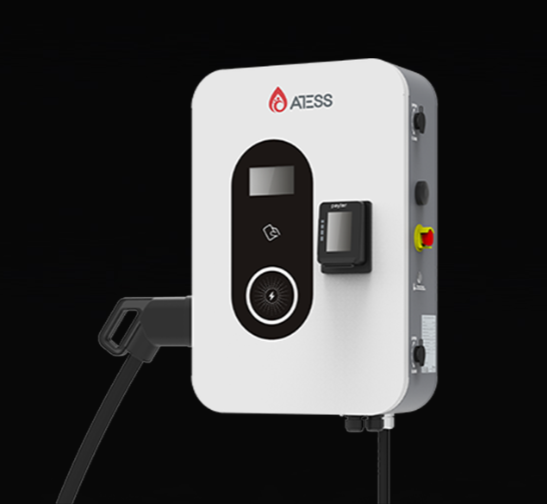
After a site determines that faster DC charging fits its operating pattern, specific charger functions become important. ATESS offers the EVD-20S as a fast DC charging solution for public charging stations with a CCS Type 2 single output.
The unit includes a user-friendly interface and several charging methods, including APP, optional RFID, and Plug and Charge. It also supports integration with third-party payment platforms, which can be useful for commercial charging locations that need flexible payment arrangements.
Energy management functions include dynamic load balancing and solar charging support. These features can help project operators coordinate charging demand with wider site energy planning.
The solution also uses WSS communication for digital intrusion prevention, adding a cybersecurity consideration to connected charging operations.
Choosing Between AC and DC for the Site
AC charging usually fits locations where vehicles remain parked for longer periods and rapid turnaround is not a major requirement. DC charging is more suitable when shorter stops, faster energy replenishment, and frequent vehicle movement are important to the business model.
Before selecting a DC EV charger, commercial buyers should review parking duration, traffic patterns, site power, installation cost, and future expansion needs together. This creates a clearer basis for equipment planning.
For projects where public fast charging is required, ATESS provides the EVD-20S with charging, payment, load-balancing, solar-charging, and communication functions. The final choice should still begin with site conditions, because charger performance delivers more value when it matches the way vehicles actually use the location.