How to Design a Restaurant Menu That Attracts New Customers
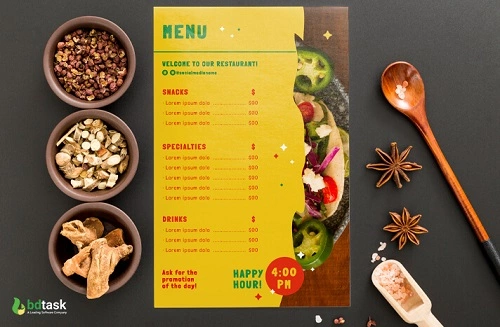
Your restaurant’s menu shouldn’t just list dishes and prices. It’s a reflection of food quality, branding, and the customer decision-making process. Your menu should be thoughtfully designed, keeping customer needs and hiccups in mind. With this, you can ensure that the dining experience at your establishment is smooth from the start.
In this blog, we’ll go over 8 strategies that will help you create professional menus without any prior graphic design experience. Let’s dive in!
8 Strategies For Designing a Restaurant Menu
Here are practical tips for menu branding, design, and printing.
1. Organize menu into clear sections
It’s best to divide your dishes into clear and logical categories. This way, customers can conveniently find what they’re looking for without having to skim over and over again. If you serve a larger menu, include sub-categories such vegetarian options, grilled favourites, or house specialties.
Here are some simple rules for creating sections:
- Consistent headings for each section.
- Related dishes should be placed together.
- Arrange items in the same order as the dining experience.
- Don’t create too many sections.
Doing so makes ordering at a restaurant a less overwhelming experience for new customers.
2. Choose the right fonts and layout
You might be tempted to clutter your menu with decorative elements. However, to maintain readability, customers need to distinguish dish names and prices under a time crunch. Here are best practices to keep in mind:
- Choose 1-2 fonts only.
- Use different weights of the same font family.
- Dish names should be prominent.
- Descriptions should be skimmable.
- Prices should be easy to locate.
Use free menu templates to start off with a structured and ready-to-edit layout. Simply, add branding colours, fonts, and logos to customize your menu.
3. Include high-quality and strategic food photography
Don’t add a picture besides every single item on the menu. Choose a few high-quality photographs of food that best represents your restaurant. You can include naturally appetizing items such as burgers, desserts, or a plated starter.
Ensure that your images are well-lit and high-resolution. Similarly, keep the background a contrasting colour so the customer’s focus firmly remains on the food. Don’t add pictures that may misrepresent the actual dish by falsely marketing its ingredients or portion size.
4. Prioritize your restaurant’s branding elements
Your menu shouldn’t be a separate design altogether. Instead, choose fonts, illustrations, and imagery that match the theme and vibe of your restaurant. It’s important to keep consistency in mind when you’re designing menus, displays, leaflets, or digital promotions.
Pro tip: Avoid placing branding elements everywhere, your dishes should remain the focal point.
5. Write short, punchy, and appetising dish descriptions
A short description is important if you want to explain a dish’s appeal to the customer. Keep descriptions informative and full of appetising adjectives. Focus on writing about flavours, ingredients, preparation techniques, and important dietary information.
If you’re new to menu design, use an AI background remover to remove distracting elements from food photography.
Pro tip: Make vegan, gluten-free, or vegetarian dishes easy to find. Only add accurate labels and information about allergens according to food-safety guidelines.
6. Display prices consistently and visibly
Make prices easy to find. Add prices underneath each dish and use the same formatting throughout the menu. Similarly, add descriptive and transparent labels such as distinguishing between portion sizes. A common mistake designers make is mixing currency formats or using inconsistent decimal places.
To prevent errors, review your menu when costs or portion sizes change. Your menu shouldn’t claim to offer what’s not actually available.
7. Highlight specialty items or signature dishes
Use a subtle border, a small icon, or a short label to highlight your restaurant’s bestselling dishes. You can also feature a seasonal item, chef’s recommendation, or a trendy dessert. However, these highlights should be few and selective so they create an impact on the customers’ dining choices.
Review your sales data every now and then to identify which dishes should be featured on the menu.
8. Create different versions for different purposes
One layout may work well for printed menus but may not be readable on a smaller screen like a phone or an iPad. It’s important to create multiple variations of your menu suited to different promotional formats.
Printed menus require strict dimensions and print-ready quality. On the other hand, mobile menus are more effective when they include larger text, shorter description, and a mobile-friendly layout.
Pro tip: Use the one-click resize tool to adapt a single design into different dimensions for other social media platforms. Re-check each version to ensure text, images, and prices are consistent.
Conclusion
A successful restaurant pairs elegant design with thoughtful practicality. Organize your dishes in order, choose readable fonts, insert appetising food images, and tweak descriptions and prices accordingly. By making small improvements to your menu, you can give customers a professional and cohesive dining experience that’s one to remember.