
Selecting Between the STM32F405RGT6 High-performance 32-bit Microcontroller (MCU) and Custom Logic Arrays
Embedded hardware development requires engineering teams to balance algorithmic throughput, board layout area, power dissipation, and total expenditure. Navigating early design stages demands choosing between sequential instruction execution and concurrent programmable fabrics. Selecting an ill-suited architecture risks inflating peripheral component counts and extending delivery schedules.
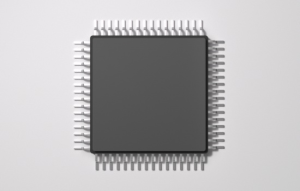
Deploying the STM32F405RGT6 High-performance 32-bit Microcontroller (MCU) equips engineering teams with a deterministic Arm Cortex-M4 core reaching 168 MHz. Dedicated floating-point hardware and digital signal processing instructions accelerate complex control loops. Such monolithic silicon satisfies heavy computational workloads while preserving compact board real estate.
Demanding applications involving parallel high-speed digital filtering, beamforming, or proprietary communications protocols present different challenges. Microcontrollers handle operations sequentially through interrupt vectors and internal registers, whereas logic gates evaluate inputs simultaneously. Hardware designers evaluate both approaches to match computational mechanics with precise operational demands.
Execution Mechanics: Pipelined RISC versus Spatial Logic
Sequential architectures execute code through pipelines that fetch, decode, and execute instructions in order. STMicroelectronics incorporates its proprietary Adaptive Real-Time (ART) Accelerator, eliminating flash memory wait states up to maximum operating frequencies. Dedicated internal buses balance traffic without stalling time-sensitive arithmetic calculations.
Massive channel counts and microsecond response windows often stress sequential processing limits. Intensive DSP algorithms operating on wide parallel data streams can saturate single-core processor bandwidth, creating software interrupt overhead that impairs responsiveness. Real-time control loops must remain free of latency spikes caused by shared register contention.
Programmable logic resolves throughput bottlenecks by distributing look-up tables, flip-flops, and dedicated DSP blocks across an uncommitted spatial matrix. Instead of multiplexing calculations across one arithmetic logic unit, hardware description code instantiates independent physical circuits. Data paths execute in pure hardware, delivering deterministic throughput regardless of concurrent system routines.
Pricing Dynamics and Peripheral Overhead Across the FPGA Market
Shifts across the global FPGA market highlight distinct bill-of-materials realities for commercial manufacturers. Comparing FPGA and microcontroller costs requires considering the complete design, including external components, board layout, development tools, and engineering time. Ancillary layout components substantially influence final hardware expenditures.
Supporting programmable logic requires specialized multi-rail power supplies, sequenced voltage monitors, external boot configuration flash, and high-density PCB stackups. Microcontrollers package internal voltage regulators, flash arrays, and clock oscillators directly onto monolithic silicon. Consequently, single-chip control designs substantially reduce passive component counts and board fabrication layers.
Toolchain licensing structures further differentiate these two hardware methodologies. Standard microcontroller development leverages open-source compilers, standard debug probes, and royalty-free runtime libraries. Conversely, high-density programmable logic ecosystems frequently necessitate costly software tool seat licenses, synthesis suites, and proprietary intellectual property core royalties that elevate upfront capital expenditures.
Mixed-Signal Peripheral Integration and Board Footprint
Engineers working with the STM32F405RGT6 High-performance 32-bit Microcontroller (MCU) benefit from dense analog and communication peripheral integration within a 64-pin LQFP measuring 10 by 10 millimeters. Combining three 12-bit analog-to-digital converters, dual DACs, and advanced timers on one die minimizes external signal routing across sensitive boards.
Integrated analog conversion blocks achieve interleaved sampling up to 7.2 MSPS across multiplexed channels. Standalone programmable logic devices rarely feature precision analog inputs, necessitating supplementary data converter ICs, level translators, and external references. Consolidating mixed-signal paths onto monolithic silicon shrinks footprints and mitigates noise coupling.
Hardware pulse-width modulation timers deliver dedicated signal generation for brushless motor commutation and switching power converters. Operating independently from central processor execution, integrated timer peripherals trigger direct memory access transfers without processor intervention. Such hardware autonomy guarantees jitter-free gate drive signals while freeing execution headroom for supervisory application firmware.
Firmware Velocity and Long-Term Maintenance Costs
Software development timelines strongly favor standard microcontroller environments in fast-moving commercial programs. Writing firmware in standardized C or C++ enables development teams to reuse established device drivers, real-time operating systems, and certified communications libraries. Accelerating software validation translates directly into earlier market introduction and lowered engineering labor overhead.
Firmware maintenance and remote field updates present distinct operational advantages throughout multi-year production deployments. Patching control algorithms, refining communications security, or introducing functional improvements involves straightforward bootloader execution or over-the-air firmware updates. Recompiling, timing-closing, and verifying complex hardware bitstreams for field upgrades introduces far greater regression testing risk.
Supply Chain Integrity and Quality Assurance
Unibetter distributes a wide range of electronic components to support industrial manufacturers navigating microcontroller and programmable logic architectures. Maintaining steady production runs requires dependable distribution partners capable of managing lead-time volatility, allocation shifts, and factory notifications across active silicon lifecycles.
Guaranteeing authentic parts requires uncompromising incoming controls. Unibetter sources and procures electronic components from franchised sources to guarantee 100% authentic, quality-assured and brand-new electronic components. Comprehensive incoming verification, including lot traceability review, visual inspection, and packaging checks, ensures that critical semiconductors meet factory specifications before surface-mount assembly.
Procurement volatility across the modern FPGA market reinforces why supply chain audits, lot traceability, and strict counterfeit screening remain vital for mission-critical hardware builds. Supporting customers to locate needed electronic components and acquire them at lower costs, Unibetter delivers procurement assistance that keeps manufacturing running during market allocations.
Platform Decision Framework for Hardware Teams
Selecting between microcontrollers and programmable logic requires matching project requirements against architectural strengths. When hardware designs demand custom interfaces, extreme channel concurrency, or sub-microsecond processing, reconfigurable logic justifies higher board complexity. Systems requiring extensive analog acquisition, standard industrial buses, and rapid firmware development achieve superior balance with monolithic processors.
System architects who ground component selection in total acquisition cost, firmware maintainability, and verified sourcing pathways protect product reliability. Evaluating operational metrics alongside production realities ensures that finished electronic assemblies deliver optimal performance throughout extended product life cycles.