Fixed Or Flexible Classroom Seating? How To Choose For Different Teaching Methods
The right lecture seating arrangement does more than provide a place to sit. It influences how easily students can see instructional content, participate in discussion, take notes, and move through the room. Fixed rows may suit presentation-heavy teaching, while flexible layouts can support collaborative activities and changing class formats. Leadcom seating can be considered within this broader planning process, particularly when durability, circulation, desk integration, and maintenance are part of the specification.
Teaching Methods And Seating Requirements
A lecture built around extended presentations usually benefits from clear sightlines and consistent orientation. Fixed positions keep students facing the instructor and display surface, while narrow row spacing can make efficient use of a limited floor area. Such arrangements are particularly useful in large classrooms where hundreds of students may need an unobstructed view.
Discussion-based courses require a different approach. Students may need to turn toward classmates, form temporary groups, or move between activities without creating congestion. Here, the value of lecture seating lies less in simply maximizing capacity and more in supporting the teaching pattern expected inside the room.
Fixed Layouts And Space Efficiency
Fixed systems create predictable rows, which simplifies circulation planning and gives every seat a defined position. Designers can calculate aisle widths, desk alignment, viewing angles, and accessible spaces before installation. This consistency also helps maintain an orderly appearance during high-frequency academic use.
However, fixed furniture can restrict how quickly a classroom adapts to different teaching styles. A room designed entirely around forward-facing instruction may become less suitable for workshops or collaborative lessons. The decision therefore depends on the academic program rather than floor area alone.
Flexible Seating For Collaborative Learning
Movable or pivoting furniture introduces another layer of adaptability. Students can face forward during a lecture and then shift toward nearby classmates for group work. Such systems are especially useful in institutions where the same room serves several departments with different instructional requirements.
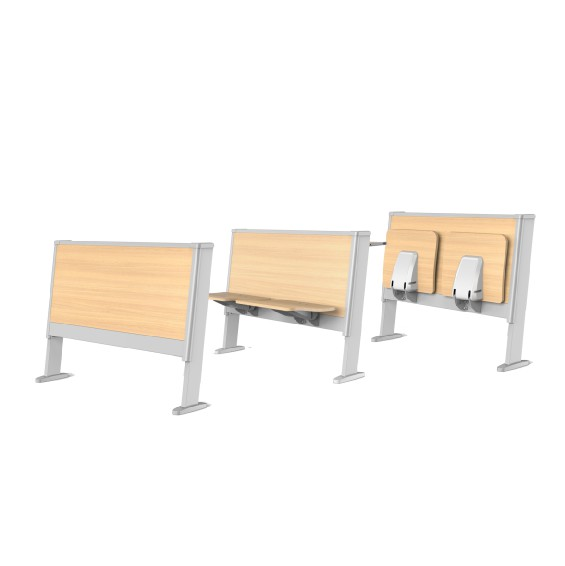
The KYLE LS-428 provides one practical example of this approach. Its seat uses 16 mm-thick plywood with a laminate finish, while the desk can be specified with a fixed or fold-down tabletop. A silent spring return mechanism brings the seat back into position after use, helping maintain clear passageways without requiring students to manually reset every chair.
Desk Integration And Student Comfort
Furniture selection should account for the relationship between the seat, writing surface, and student posture. A desk positioned too far away can encourage leaning, while insufficient knee clearance may make extended classes uncomfortable. Appropriate dimensions should therefore be considered alongside seat width and row geometry rather than evaluated independently.
Material selection also affects the experience over many academic terms. Laminate surfaces are practical in classrooms because they can be cleaned regularly, while plywood and steel structures can provide a solid foundation for frequent use. Leadcom seating models such as the KYLE LS-428 demonstrate how integrated desks and seats can combine practical maintenance considerations with a more organized classroom layout.
Circulation, Maintenance And Accessibility
A classroom may look spacious on a floor plan yet become difficult to navigate once desks, backpacks, and occupied seats are taken into account. Main aisles should connect entrances with teaching zones and accessible positions without forcing students to cross heavily occupied areas. Fold-down or self-returning components can also help preserve circulation paths after each class. Well-planned circulation routes can ease daily movement and reduce the likelihood of congestion around seating areas.
Maintenance deserves similar attention. High-use educational furniture is exposed to repeated sitting, writing, cleaning, and occasional impact. Specifications should therefore cover surface durability, mechanical movement, structural materials, replacement access, and cleaning requirements. A design that performs well technically but requires complicated servicing may create unnecessary operational costs.
Matching Furniture With Long-Term Campus Needs
A suitable classroom system depends on enrollment patterns, room dimensions, teaching methods, and the institution’s plans for future use. A highly specialized room may justify fixed furniture, whereas a multipurpose teaching space can benefit from greater adaptability. Budget planning should also include installation, maintenance, replacement components, and the expected service environment.
Capacity should never be considered separately from usability. Adding more seats can reduce aisle space, limit accessibility, or make movement difficult between sessions. A balanced specification instead considers how many students can be accommodated while preserving reasonable circulation, visibility, writing space, and comfort.
Conclusion
Selecting classroom furniture is ultimately an exercise in matching physical design with educational activity. Fixed arrangements provide consistency and predictable capacity, whereas adaptable systems can respond more readily to collaborative instruction and mixed teaching formats.
The KYLE LS-428 illustrates how a fold-down desk, self-returning seat mechanism, plywood seating surface, and powder-coated steel support can address several practical requirements within one system. Careful planning allows lecture seating to contribute to both daily teaching efficiency and long-term room usability, while Leadcom seating can serve as one reference point when comparing integrated educational furniture options.